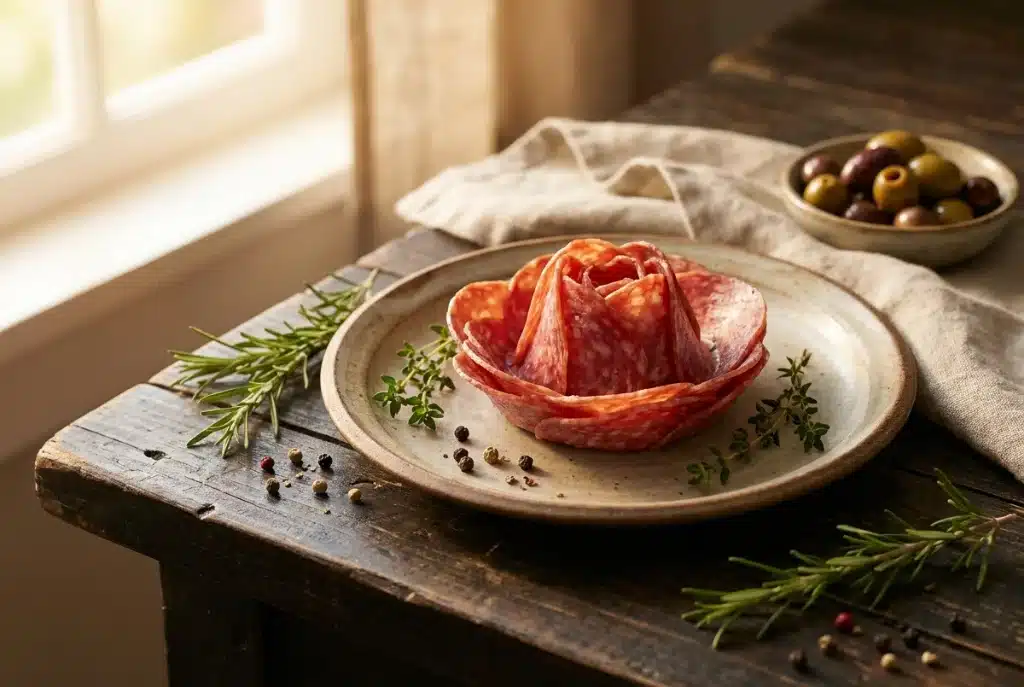
A salami flower is honestly one of those party tricks that looks impossibly fancy but takes maybe three minutes per bloom once you get the hang of it. I still remember the first time I brought a board covered in these little roses to my neighbor Melissa’s holiday party. People genuinely thought I’d ordered it from a catering company. Nope. Just me, a pack of Genoa salami, and my kids crowding around the kitchen counter asking if they could help.
To make a salami flower, fold thin deli slices over the rim of a wine glass, layering each piece so it overlaps slightly and forms petal shapes. Press the base gently, slide the flower off, and place it on your board. The whole process takes 2-3 minutes per flower with no special tools required.
I’ve been making these for holiday boards every November and December for the past four years, and I’ve dragged my daughter Léa and my son James into the process every single time. It’s become one of our favorite pre-party traditions. This guide covers everything: the right salami to buy, the exact folding method, how to keep flowers from collapsing, and how to build a board that makes everyone stop and stare. This really is the only salami flower tutorial you’ll ever need.
The Exact Salami Type That Makes Perfect Flowers Every Time
Not all salami is created equal when you’re trying to make a salami flower. I learned this the hard way. The first time I attempted these, I grabbed a pre-packaged salami log from the grocery store shelf, sliced it myself, and ended up with stiff discs that cracked when I tried to fold them. Disaster. Total waste of salami.
The difference between a gorgeous, petal-soft bloom and a crumbling mess comes almost entirely down to how the salami is sliced. You need deli-thin. Think the thickness of a piece of deli ham, or even a hair thinner. When you hold a slice up to the light, it should be almost translucent around the edges. That flexibility is what lets you fold it without tearing.
Ask your deli counter person specifically for “paper-thin” slices. Most delis can go down to about 1mm or even thinner on request. And honestly, fresher is better here too. Salami sliced within the last two or three days has more moisture and pliability than something that’s been sitting in a package. If you’re planning a holiday board for Christmas or Thanksgiving, pick up the salami the day before you plan to assemble everything.
If you want to add an impressive appetizer that pairs beautifully alongside your flower board, our tortellini kabobs are always a crowd-pleaser at holiday gatherings and they’re just as easy to make with kids.
Why Thin-Sliced Genoa Salami Folds Better Than Any Other Cut
Genoa salami is the gold standard for the salami rose technique. It’s got a fine-grained texture, a moderate fat content, and a slightly softer consistency than harder varieties like soppressata or pepperoni. That fat content matters more than you’d think. Fat in the meat makes the slice pliable rather than brittle.
Soppressata can work, but it tends to be a bit drier and firmer. It still folds, but you have to be a little more careful. Harder salami varieties, like some of the Hungarian or Spanish styles, are genuinely difficult to fold without tearing. They look beautiful on a board, but for actual flowers, stick to Genoa or a good quality Milano salami.
The size of the slice matters too. Standard round deli salami runs about 3.5 to 4 inches in diameter. That’s pretty much the ideal size for building a flower with 6 to 8 petals. Smaller slices produce cute mini flowers but they’re a little trickier for beginners and kids. Go standard size while you’re learning.
Which Salami Brands Hold Their Shape on a Charcuterie Board
I’ve tried a bunch of brands over the years. Boar’s Head Genoa salami sliced fresh at the deli counter is my personal go-to. Consistently thin, consistently flexible, and the flavor is excellent. Volpi is another brand I love, especially their Genoa. Columbus Craft Meats also makes a really nice salami that holds its shape beautifully.
For a budget-friendly option, the store-brand deli salami from most major grocery chains works just fine as long as you get it sliced thin. The brand matters less than the slice thickness. Pre-packaged salami in resealable pouches is generally too thick and too dry for flower-making. I’d avoid those for this project.
| Brand | Best For | Shape Retention | Kid-Friendly |
|---|---|---|---|
| Boar’s Head Genoa (deli) | Best overall | Excellent | Yes |
| Volpi Genoa | Premium boards | Excellent | Yes |
| Columbus Craft Meats | Everyday use | Very Good | Yes |
| Store-brand deli sliced | Budget option | Good (if thin) | Yes |
| Pre-packaged (pouch) | Not recommended | Poor | No |
Zero Special Tools Required for Your Salami Flower
One of the reasons I love teaching the salami flower technique to my kids is that there’s genuinely nothing intimidating about the setup. No special gadgets. No pastry training. Just your hands and a couple of things you already own.
Here’s what you actually need on your counter: a pack of thin-sliced salami, a wine glass or small ramekin, a damp paper towel or small bowl of water to keep your fingers moist, and your serving board. That’s it. Honestly. I’ve seen tutorials online trying to sell flower-shaping molds and specialized charcuterie tools. Save your money.
Can a Wine Glass Replace Every Fancy Flower-Folding Tool
Yes. Absolutely yes, and this is the method I use every single time. The rim of a standard wine glass (around 3 inches in diameter) is the perfect form for building a salami flower. You drape slices over the rim, fold them down, layer them up, and the glass holds the shape for you while you work. Then you just press the base, flip it over, and place it right onto your board.
A small Mason jar works equally well. So does a large-mouthed ramekin or even a small cup. The key is finding something with a rim diameter of roughly 2.5 to 3.5 inches. Too small and the flower looks cramped. Too large and it falls apart when you try to remove it. I tested this with James, who is nine, and he had a perfectly shaped flower on his third attempt using a Mason jar. Kids can absolutely do this.
Some people use their finger to build the flower’s center, then layer petals around it freehand. That works too, and it’s a great technique once you’re comfortable. But for beginners, especially little ones, the wine glass method is so much more forgiving. The glass does half the work for you.
Family-Friendly Setup Any Beginner Can Assemble in Minutes
Here’s how I set up the counter when Léa (she’s twelve) and James help me. I put out the salami slices fanned out on a plate. Next to that, a small bowl of water. Then the wine glass and the serving board at the end. Assembly line style. It makes the process feel organized and the kids know exactly where to reach.
I always do a quick demonstration flower first so they can see the layering pattern. Then I step back and let them try. The first flower usually looks a little lopsided. By the second or third, they’re genuinely producing beautiful blooms and they know it. There is something so satisfying about watching a kid beam with pride over a salami rose they made themselves.
One practical note: keep a damp paper towel nearby. Salami can get slippery when you’re working fast, and a quick wipe between flowers keeps your hands from getting too greasy. Totally manageable for kids ages 7 and up.
Salami Flower Recipe
Ingredients
- 24-32 slices thin-sliced Genoa salami (paper-thin from deli counter)
- 1 wine glass or small Mason jar (for shaping)
- 1 small bowl of cold water (to keep fingers moist)
- 1 serving board or platter
- Toothpicks (optional (for securing base))
- Parchment paper (optional (for prepping ahead))
Instructions
- Chill your salami. Before you start, refrigerate the salami for at least 30 minutes. Cold salami holds its shape dramatically better than room-temperature slices. This single step makes everything easier.
- Set up your glass. Hold your wine glass upside down or right-side up with the opening facing you. You'll be draping slices over the rim to build the flower.
- Create the center. Take one slice of salami and fold it in half, then fold it in half again to create a small cone or bud shape. This is the heart of your flower. Set it inside the top of the glass opening.
- Add the first ring of petals. Take 3-4 slices and fold each one in half. Drape each folded slice over the rim of the glass, curved side down, so the folded edge hangs over the inside and the curved edge forms a petal shape on the outside. Space them evenly around the rim.
- Build the second ring. Take 4-5 more slices, fold them in half, and position them between the petals of the first ring, slightly lower and offset. Each new petal should peek out between the previous ones.
- Add a third ring if desired. For a fuller, more dramatic salami flower, add a third ring of 5-6 folded slices, again offset from the second ring and positioned slightly lower.
- Compress the base. Gently but firmly press all the bases of the petals together at the bottom of the glass opening. This is what holds the whole flower together. Press for about 10 seconds.
- Transfer to the board. Carefully slide two fingers under the base of the flower, keeping the petals pressed together, and transfer it directly to your serving board or a piece of parchment paper. Set it base-down so the petals bloom upward.
- Adjust the petals. Use your fingertip to gently open and fan any petals that look too tight. A little adjustment goes a long way. The flower should look full and slightly open, like a blooming rose.
- Repeat for all flowers. Continue making flowers until you have as many as you need. Refrigerate completed flowers until you're ready to assemble the full board.
Notes
Dampen your fingertips slightly while working. This gives you better grip on the salami and prevents the slices from slipping while you layer.
If a flower collapses, don't throw it out. Press the base firmly for 10 full seconds and then refrigerate it for 20 minutes. It'll often firm right back up.
For a kid-friendly version, let children use a small ramekin instead of a wine glass. The wider, sturdier base is easier for small hands to manage.
Offset each ring of petals by rotating about half a petal-width between layers. This creates that true rose silhouette rather than a layered stack look. 💡 Troubleshooting Tips: Flowers falling apart: slices are probably too thick. Head back to the deli and ask for thinner cuts.
Petals won't stay in place: compress the base more firmly for a full 10 seconds before transferring.
Flowers look flat: you need more upward angle on each ring. Tilt petals slightly upward as you drape them over the glass rim.
The Salami Rose Folding Technique Explained From Every Angle
The salami rose technique is really all about understanding how the layers build on each other. Once you see it in your mind, everything clicks into place. And I mean that literally. The third time I made these, something just clicked and I went from slow and uncertain to confident and fast.
The core concept is simple: each fold creates a petal. Each petal gets layered slightly behind and below the previous one, which creates that depth and dimensionality that makes the flower look like a real bloom. You’re not just stacking flat circles. You’re creating visual depth by offsetting each ring.
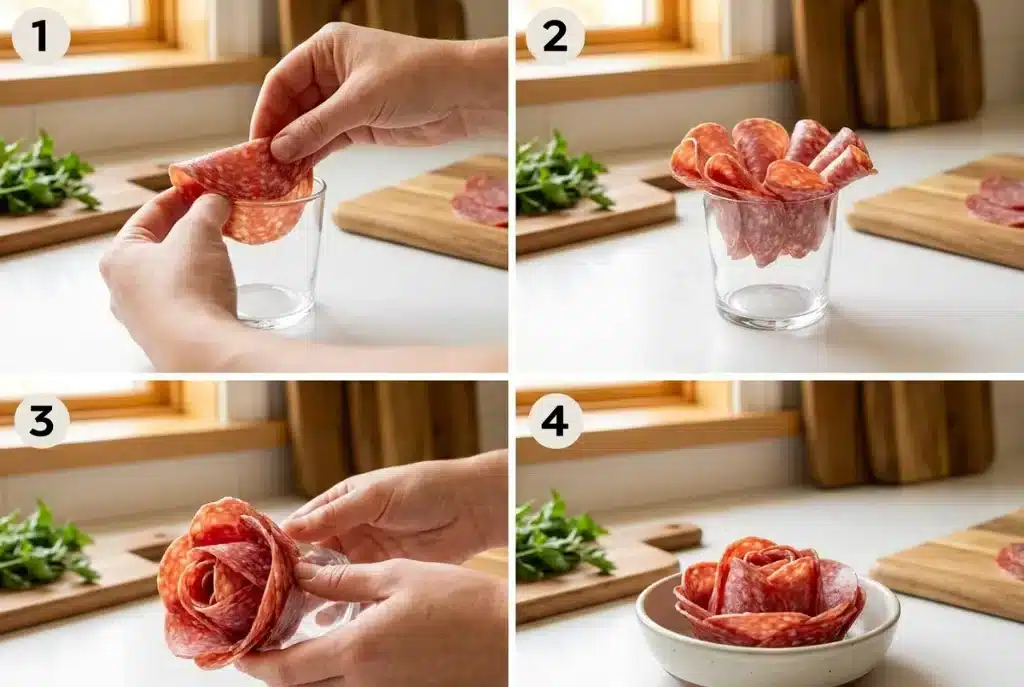
How Each Fold Stacks to Build a Full Blooming Rose Shape
Let’s break it down ring by ring. The center is the tightest part. You’re creating a small, fairly firm cone that gives the flower its interior structure. Think of it like the heart of a real rose. Tight, closed, pointing upward.
The first ring of petals opens slightly from that center. These petals are folded in half and draped so their fold line is at the top and the two loose corners hang down. That fold line is what creates the curved, petal-like silhouette. Four petals in this ring, evenly spaced, gives you a natural-looking flower.
The second ring opens even further. These petals sit a little lower and between the gaps of ring one. Their fold is slightly less tight, which lets them flare out more. Five petals here gives good coverage. By the time you add a third ring of six slightly looser petals at the very base, you’ve got something that genuinely looks like a rose. The smell of cured meat, the deep red color of the salami against a white marble board… honestly stunning.
According to the USDA FoodData salami nutritional profile, Genoa salami is a good source of protein and pairs well with the fats in aged cheeses, which is part of why a charcuterie board is so satisfying as a combination.
Front, Side and Top View: What a Finished Salami Flower Should Look Like
From the front: you should see 3-4 layers of overlapping petal rings, each one slightly recessed behind the next. The outermost petals flare out the widest. The center should look slightly closed and dimensional, not flat.
From the side: the flower should have height. Not flat like a pancake. A finished salami flower stands about 1.5 to 2 inches tall when properly layered. If yours is flat, you’re not building the rings with enough upward angle. Tilt each petal ring slightly upward as you drape it.
From the top: you should see a spiral pattern, like a real rose viewed from above. The center is a tight bud. Each ring of petals peeks out from beneath the one above it. If it looks more like a jumbled pile, the petals aren’t offset enough between rings. Step back, pull it apart gently, and start the second ring again, this time making sure each petal sits squarely between two petals from the previous ring.
How Long It Really Takes to Build a Salami Flower Charcuterie Board
I’ll be honest with you: your first salami flower will probably take you five minutes. Maybe six. That’s normal and totally fine. Don’t rush it. But by your fourth or fifth flower, you’ll be moving in about two to three minutes flat, I promise.
Planning timing is important, especially during the holiday rush when you’re also making sides, managing kids, and trying not to burn the rolls. Here’s a realistic breakdown so you can plan accordingly.
Can You Make Salami Flowers Hours Before Guests Arrive
Yes, and I actually recommend it. Making your flowers 2-4 hours ahead is the sweet spot. They firm up beautifully in the fridge, the cold helps them hold their shape, and you get that pre-party chaos out of the way early. I usually make my flowers while the kids are at school on party days. Then I refrigerate them on a parchment-lined plate and assemble the full board about 30 minutes before guests arrive.
Don’t push past 6 hours, though. The edges start to dry and curl in a less attractive way. And definitely don’t make them the day before. I tried this once for a New Year’s Eve party and the flowers had lost most of their charm by the next evening. Same-day prep is the way to go.
When you’re ready to plate, pull the flowers straight from the fridge. Don’t let them sit at room temperature before placing them on the board. Cold flowers hold better, look sharper, and last longer during the party.
How Many Flowers You Need Per Board Size for a Full Display
This depends on your board size. Here’s a quick reference I’ve worked out through trial and error over the past few holiday seasons.
| Board Size | Guests Served | Flowers Needed | Assembly Time |
|---|---|---|---|
| Small (8×10 inch) | 4-6 | 3-4 flowers | 10-15 min |
| Medium (12×16 inch) | 8-12 | 5-7 flowers | 15-25 min |
| Large (18×24 inch) | 15-20 | 10-12 flowers | 30-40 min |
| Party board (24×30+) | 25-30 | 15-20 flowers | 45-60 min |
For a medium board serving 8-12 people, I typically do 6 salami flowers clustered in groups of two or three, then fill the rest of the board with crackers, cheese, and garnishes. It looks incredibly full and impressive without needing 20 flowers.
Ingredient Pairings That Make Your Salami Flower Board Go Viral
The salami flower is the star, but the supporting cast is what makes the whole board irresistible. And honestly, this is where I have the most fun. My philosophy: you want contrast. Creamy next to crunchy. Mild next to sharp. Dark next to light. Color everywhere.
I’ve experimented with probably a dozen different board combinations over the years, and I’ve narrowed it down to a formula that works every single time. Let me share what I know.
Which Cheeses, Crackers and Garnishes Frame Salami Flowers Best
For cheese, I always reach for three different styles. A creamy soft cheese like Brie or camembert. A firm aged cheese like a good sharp cheddar or aged Gouda. And something with a little funk, like a mild blue or a creamy Gorgonzola. Together they cover every palate at the table.
Crackers should vary in texture. I do one plain water cracker (neutral, doesn’t compete with the salami), one buttery round cracker, and one seeded or herbed variety for visual interest. Arrange them in little stacks and fans around the flowers. They fill space beautifully and are dead easy to arrange.
Garnishes are where the board comes alive. Fresh rosemary sprigs tucked around the flowers make them look like they’re nestled in a garden. Sliced cornichons add a bright green pop. Fresh grapes (red and green together) add color and sweetness. A small pot of honey and a little dish of whole-grain mustard round it out perfectly.
Color and Texture Combos That Make the Whole Board Pop
The deep red of the salami flower reads gorgeous against white cheeses. So lean into that contrast. Position your flowers near white Brie wedges or rolled cream cheese bites. The color difference is striking even in photos, which is part of why these boards go viral on Instagram and Pinterest every holiday season.
For texture contrast, think soft, firm, and crunchy in every section of the board. You never want a corner that’s all crackers or all cheese. Weave them together. A cluster of flowers, surrounded by a few crackers, a wedge of cheese, a small grape cluster, and a rosemary sprig. That’s a complete vignette right there.
Green from the rosemary and grapes, white from the cheeses, red from the salami flowers, golden from the crackers and honey. That’s your color story, and it’s a genuinely beautiful one. If you’re planning a holiday spread, this board alongside something warm and cozy like our French onion chicken orzo casserole makes for a truly memorable table.
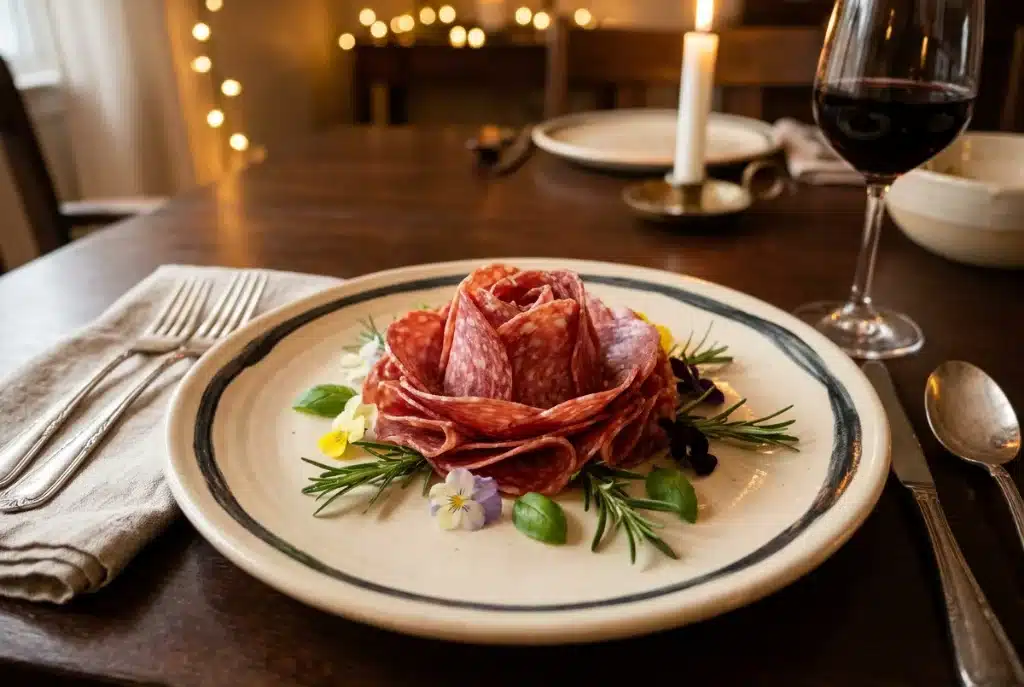
- Always chill your salami for 30 minutes before folding. Cold slices hold their petal shape dramatically better than room-temperature ones.
- Dampen your fingertips slightly while working. This gives you better grip on the salami and prevents the slices from slipping while you layer.
- If a flower collapses, don’t throw it out. Press the base firmly for 10 full seconds and then refrigerate it for 20 minutes. It’ll often firm right back up.
- For a kid-friendly version, let children use a small ramekin instead of a wine glass. The wider, sturdier base is easier for small hands to manage.
- Offset each ring of petals by rotating about half a petal-width between layers. This creates that true rose silhouette rather than a layered stack look.
The One Trick I Discovered That Stops Salami Flowers Falling Apart
Okay, real talk. My first holiday board with salami flowers? Two of them basically dissolved into floppy piles within twenty minutes of hitting the counter. I was mortified. Melissa kept being polite about it but I could see her trying not to notice. I spent the next week figuring out exactly what went wrong, and I found two specific fixes that changed everything.
The good news: both fixes are completely simple. No fancy technique required. Just two things I wish somebody had told me before that party.
Why Cold Temperature Before Plating Is the Real Secret Weapon
This is the big one. Cold salami holds its shape. Warm salami doesn’t. It sounds obvious when you say it out loud, but I wasn’t doing it. I was pulling salami straight from the fridge for the chilling part, but then letting my finished flowers sit on the counter while I built the rest of the board, sometimes for 15-20 minutes before everything went in the refrigerator together.
That’s too long. Once a salami flower hits room temperature, the fat in the meat starts to soften slightly, which loosens the petal structure. The fix is simple: as you finish each flower, refrigerate it immediately on a parchment-lined plate. Only pull them out to transfer directly to the final board right before serving.
Working in a cool kitchen helps too. In the summer, I’ll actually crank my AC down while I assemble charcuterie boards. In December, this is less of an issue, but it’s worth knowing.
The Toothpick Method Nobody Talks About for Long-Lasting Flowers
This is my second discovery, and it’s a total game changer for parties where the board will be sitting out for a couple of hours. Once your flower is assembled and the base is pressed together, slide one toothpick up through the center of the base. Just one. Push it in about halfway. This pins the inner layers of the flower together without being visible from the top.
The toothpick acts like a little anchor. Even as the flower warms up slightly on the board, that center is held in place. The outer petals can relax a little without the whole thing collapsing because the heart of the flower is secure.
Just make sure you tell your guests there are toothpicks in the flowers, or put a small note near the board. Nobody wants to bite into a toothpick. I usually write it on a little card: “Flowers secured with toothpicks – please remove before eating!” Cute and functional. If you love this kind of decorative food presentation, you’ll get a kick out of our fun recipes kids will love making, which is full of projects just as creative as this one.
- Flowers falling apart: slices are probably too thick. Head back to the deli and ask for thinner cuts.
- Petals won’t stay in place: compress the base more firmly for a full 10 seconds before transferring.
- Flowers look flat: you need more upward angle on each ring. Tilt petals slightly upward as you drape them over the glass rim.
The salami rose technique grew out of Italian-American charcuterie traditions, where beautifully arranged cured meats are a centerpiece of festive antipasto spreads. The flower-folding style gained mainstream popularity through social media around 2018-2020, when home entertainers started sharing their holiday boards widely on Instagram and Pinterest.
This almost always comes down to temperature. Salami flowers need to go straight from the fridge to the board, not from the counter. If they sat at room temperature for even 15-20 minutes before plating, the fat in the meat softens enough to loosen the petal structure. Next time, refrigerate your finished flowers immediately and only transfer them to the board right before serving. The toothpick method I describe above is also a great backup for long parties.
Frequently Asked Questions About Salami Flower
How do you make a salami flower step by step?
Start by selecting thin-sliced salami from your deli counter. Fold one slice into a tight cone for the center, then layer additional folded slices around it over a wine glass rim, slightly overlapping each piece to create petal-like formations. Gently press the base firmly for 10 seconds to hold the shape. Transfer to a parchment-lined plate and refrigerate. Most salami flowers take 2-3 minutes once you understand the layering pattern, and the technique becomes intuitive quickly.
What type of salami is best for making flowers
Thin-sliced Genoa salami is the gold standard. Ask your deli counter for paper-thin slices, about the thickness of deli ham or even thinner. Classic Italian varieties like Genoa, Milano, or soppressata work excellently. Avoid pre-packaged salami pouches, which tend to be thicker and more brittle. Fresher salami, within 2-3 days of slicing, is more pliable and much easier to fold without tearing.
Do you need special tools to make salami flowers
No special tools are required at all. Most people make a salami flower using only their fingers and a wine glass or small ramekin as a shaping form. A small bowl of water to keep fingers moist and a piece of parchment paper to rest finished flowers are helpful but optional. Once you’re comfortable with the technique, you can work entirely freehand on your serving board without any forms at all.
Can you make salami flowers in advance
Yes! Making flowers 2-4 hours ahead is actually ideal. Refrigerate them on a parchment-lined plate in the coldest part of your fridge. The cold temperature firms them up and helps them hold their shape. Don’t make them more than 6 hours early, as the edges can start to dry. Transfer directly from the fridge to your board right before serving for the best results and longest display life.
How long does it take to make salami flowers
Individual flowers take 2-3 minutes once you’re comfortable with the technique. Your first few may take 4-5 minutes as you learn the petal-layering pattern. For a medium board serving 8-12 guests, plan for 5-7 flowers, which totals roughly 15-25 minutes of assembly time. First-time makers should add an extra 10-15 minutes for practice. The learning curve is very forgiving and most people find a confident rhythm by the third flower.
Why is my salami flower falling apart
There are three main culprits: slices that are too thick and brittle (ask for thinner cuts at the deli), layering that’s too loose without a firmly compressed base (press the base for a full 10 seconds), or salami that’s too dry (use fresher salami within 2-3 days of slicing). Keeping your fingertips slightly moist while working also helps edges grip together. And the toothpick method described in this guide is a reliable fix for flowers that won’t stay together on the board.
Can kids help make salami flowers
Absolutely, and it’s one of my favorite kitchen activities to do with my kids. Children ages 7 and up can manage the folding and layering process, especially using a small ramekin or Mason jar as a form. Set up a simple assembly line with the salami fanned out, a water bowl for moist fingers, and the shaping form. Do a demonstration flower first, then let them take over. By the third attempt, most kids are making beautiful blooms entirely on their own.
The first holiday season I tried making a salami flower charcuterie board, I genuinely thought I was going to impress absolutely everyone. And I did… eventually. But not before two flowers collapsed into sad little salami piles in front of my guests. I stood there holding a wine glass, my face very red, while James (who was six at the time) loudly announced “Mommy’s flowers broke!” to the entire room. Helpful, buddy. The next year I came back armed with the cold-temperature trick and the toothpick method, and every single flower held up perfectly for the entire three-hour party. Now Léa basically runs the flower station at every holiday gathering. She’s faster than me.
Final Thoughts on Your Salami Flower Board
Making a salami flower is one of those skills that sounds way harder than it is. Once it clicks, it really clicks. And the payoff, that moment when guests see the board and genuinely gasp, is so worth the twenty minutes of prep time.
Whether you’re making these for a quiet family night, a Thanksgiving appetizer spread, or a full New Year’s Eve party board, the salami flower technique scales beautifully. Two flowers or twenty. Small board or enormous grazing table. The method is exactly the same.
Bring the kids in on it. Let them make a few lopsided ones. Those imperfect flowers made by little hands are honestly the most charming ones on the board, and they’ll remember making them long after the party is over. For more ideas on cooking and creating beautiful food with your family, stop by my about page to learn more about how Mom Tasty came to be. And if you have questions, I’m always happy to chat over on the contact page. Browse more delicious recipes at momtasty.com!